The Agony and Ecstacy of the U.S. Government's Relationship with Apple's iPhone, Part 2

Does the U.S. Government's left hand know what its right hand is doing? Stop hitting yourself, stop hitting yourself...How all 3 branches lost an opportunity to have smart phones made in America.
All thoughts, opinions, and other words here are exclusively the personal opinions of the author and do not express any official position, statement, or other communication from or on the behalf of the U.S. government. This is a work of fiction. Any resemblance to actual persons, living or dead or actual events is purely coincidental.
After my first Decennial planning meeting, I went to my boss’ boss’ boss - the Chief Acquisition Officer (CAO) who reported to the Chief Financial Officer who reported to the Census Administrator (head of Census) who reported to the Secretary of Commerce who reported to the President of the United States. The CAO was also who interviewed and directly hired me (and would end up being one of the greatest teachers I ever had).
Me: Hey we have a big problem, they want to buy iPhones for 2020.
CAO: (flips his personal phone over and sees Made in China) We can’t buy iPhones.
Me: I know.
CAO: Did you tell them that?
Me: Of course I told them that but they don’t care. They told me to figure it out.
CAO: I am not getting into trouble with Congress again.
Me: I know. I offered that we could probably use Android instead but they said it had to be Apple.
CAO: You know the ladders only go up to 7.
Me: What?
CAO: The county fire department ladders—they can only go up 7 stories.
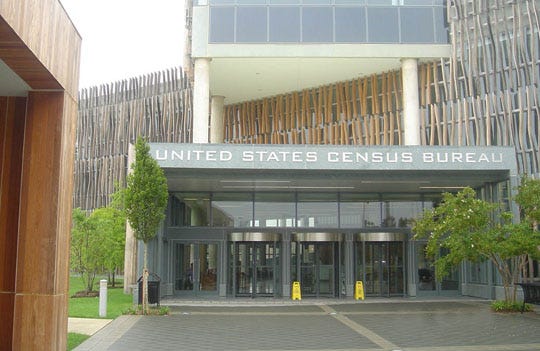
Census headquarters in Suitland, Maryland on the “Federal Campus” is an 8 story building. Like the term “back office function” implies, which is how procurement is generally seen until there’s a major failure, my CAO and his division were shoved in a corner of the 4th floor.
All of the Census executives were on the 8th floor, like the CIO demanding iPhones.
Federal government “executives” are primarily in a job series called the Senior Executive Service (SES) who received higher salaries, benefits, etc. than us schmucks in the General Schedule (GS). You might be forgiven for thinking they are part of the “deep state” but unlike GS employees, SES employees aren’t unionized—and because of this and many other elements of human resources law—they could be hired, fired, or reassigned much easier (I realize the irony of this post-DOGE and the pending implementation of Schedule F). SES employees are the “bosses” of GS employees, informally there’s lobbyists, the legislative and judicial branches, your cousin, etc.
My CAO, who was in the SES, told me about another SES who “pissed off the wrong people” and was “reassigned” to the outer Aleutian Islands in Alaska for its Decennial for a couple of years.
If there was some great conflagration, you wouldn’t want to be on the 8th floor or the SES. Both literally and figuratively in the case of 8th floor offices.
I had my CAO’s support in holding firm on this issue because of an incident that happened in the last Decennial census. At a high level, Decennial is comprised of two phases: Self-Response and Non-Response Follow Up (NRFU).
Before we send out “door knockers,” Census tries to get everyone to just give us their data voluntarily. In the good old days, Census used to physically mail the 10 question paper Decennial form to everyone, or make it otherwise broadly available through other means to everyone.
NRFU is when Census hires, trains, equips, deploys, and manages hundreds of thousands of people out to count everyone because they failed to self-respond, but we still have to legally count them.
It is the single greatest cost driver for Decennial.
The more people who fill out the Decennial survey voluntarily—the more taxpayer money is saved to accomplish the task that the Congress and the Constitution has mandated.
Every Decennial, to increase awareness and get people to fill out their surveys without us sending people to their door to read it to them and fill it out for them, there is a massive advertising campaign.
The idea was to harness the ability of small children to pester the hell out of their grown ups to do something because the glowing box told them.
In addition to television, radio, and other advertisements, Census spent taxpayer money on “swag.” Swag is always contentious, although American companies who make money from swag will lobby Congress to ensure it continues.
Swag is any and all mass-produced pens, pencils, coffee mugs, hats, tee shirts, tote bags, and other promotional items that have a brand, logo, or something else being promoted slapped onto it and sent out to the masses.
Sequestration was not the only factor that affected the mood around U.S. Government’s spending on swag in the first years of the 2010’s, there was also the General Services Administration (GSA) conference scandal—when the GSA turned swag spending up to 11 in the public’s perception (GSA plays a big role in this story):
Some of us refer to this scandal as “bathtub shrimp” because of an infamous photo of one GSA executive whose wife took a photo of him in a Las Vegas hotel penthouse. Can you imagine?! On a government salary and function?! Nice things?! Absurd!!! There wasn’t actually any shrimp in the photo.
Anyway, the last Decennial, Census had bought about $500,000 worth of tee shirts, through a subcontractor, with the 2010 Decennial logo on it. Census would give people swag hoping it would cajole them into voluntarily filling out the form. This is worth the investment because NRFU gets more and more expensive every Decennial. If 10 people who got that dumb shirt voluntarily filled out the survey it would have saved us far more money than tens of millions of dollars worth of shoddy shirts.
Unfortunately for Census, the subcontractor provided tee shirts that were manufactured in a non-Trade Agreement Act (TAA) compliant country (sometimes the paper contract says one thing but the awardee does something else—womp womp). A few people in Congress found out about this—from lobbyists—and were very, very upset. The CAO and other executives got dragged down to the Hill where they were yelled at, threatened, and generally had a very bad time.
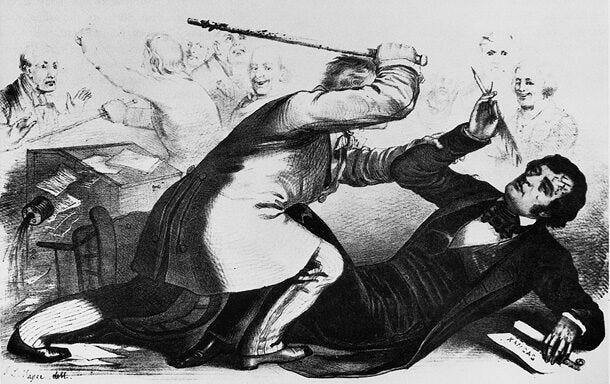
The only thing that saved my CAO and other Census SES’ers from getting into serious shit, instead of just getting yelled at, was that we had a legal loophole. We explained to Congress that we, in fact, did not break any of the laws they gave us to follow—because we complied with TAA (we didn’t explicitly say loophole).
One of the most used exceptions is something called the “substantial transformation” test. This exception allows for non-TAA base inputs so long as they are “substantially transformed” into something else in a TAA-compliant place. Taking non-TAA compliant shirts and “substantially transforming” them into advertising materials was legal. This will come up again in a later post about technology and the substantial transformation loophole “short screws in long holes.”
My CAO told me to try and figure out somehow to get them what they wanted, iPhones, but do not break the law. So I did what had been ingrained in me as a research assistant at a university for years—I researched.
Over the next year, I scoured everything to find anyone in any form of government who was buying Apple products. Because in addition to the iPhone, Apple also changed the landscape of consumer technology with the iPad. I was told I had to buy both iPhones and iPads, lots of them. So I looked for both and iPads were popping up in government first.
Over the course of many months of frantic searching, I discovered small pockets of Apple buyers. Sometimes they bought under the TAA dollar threshold, whether they realized it or not…and they usually did not. Because of Apple’s retail pricea, these “buys” were usually many times over the TAA dollar threshold.
Some of these government buyers included a war college, an Air Force unit, and dozens of others. This was back when you could actually get people to answer their phone calls. I started with the war college.
Me: Good morning is this Doctor Livingstone at the war college? (not their name)
Doc: Yes how can I help you?
Me: I saw an article you were interviewed in about those iPads to replace your textbooks (this was real popular for a while across academia) and I was hoping you could tell me more about how you bought them.
Doc: Uh I don’t know I think we put them on a credit card.
Me: (Tries to quickly—ha ha—explain the interchange between the BAA and TAA).
Doc: Interesting. Well no one has said anything about that, but thanks for letting me know.
Rather than getting into trouble for buying iPads made in China, the war college would, ironically, get into deep shit and had to cancel their iPad textbook replacement program because the software they used for their e-textbooks was made by a Russian company. To quote Gov. Rick Perry of Texas, “Oops” (amazingly, Gov. Rick Perry will come up later in this).
No one mentioned or gave a shit about the Chinese iPads.
I found and then spoke with a Lieutenant Colonel in the Air Force after finding their “sources sought” notice on FedBizOpps.gov for “iPad flight bags.”
Flight bags are, historically, huge binders of printed paper for information about the airplane and sequential procedures for a pilot to follow in every possible scenario that they may not have committed to memory (they can be thousands of pages).
Mustache No. 2 here is reading from his hard copy, paper flight bag so they didn’t all die.
Like textbooks, and the early phase of tablets, e-readers, and other screens, anything printed—like a book—was obsolete and doomed to disappear in the new world order. Besides news sources, I mainly found government buyers on the “government point of entry” and “official portal” for almost all government requests, announcements, or declarations for purchasing.
SAM.gov is now the U.S. Federal government’s “point of entry,” usually called “portal” to industry, because government is incapable of ever calling something a website.
Most of the time, the U.S. Federal government is legally required to post contracting opportunities somewhere that anyone—the public, Congress, companies, your cousin, etc.— who has any interest in the government spending money—for fairness, transparency, publicizing, or any other purposes—can see it.
But, like all things, there are loopholes and exceptions. Good 1102’s, like my CAO, are masters of loopholes and exceptions. The best can run circles around even Ivy League lawyers claiming government contract expertise which is fun to watch in real time (Ivy League lawyers will come up in a later post).
SAM.gov’s original Pokemon form in the era of tricorn hats and powdered wigs was a notice board in the town square, then in the “men and only men can wear business suits and they must wear only business suits all the time for any and all activity era” it was actually a big board in the basement of the Department of Commerce Headquarters. The big basement board then got turned into an paper publication, because they got tired of so many god damn people being in the god damn basement all the time, and then eventually an electronic newsletter called the Commerce Business Daily (CBD).
CBD then got taken over by GSA, because GSA has a long history of taking over things that actually work from other parts of government and ruining it. They renamed the CBD into FedBizOpps.gov. This was the last time it worked and I miss FedBizOpps so much.
For some reason, GSA, the “centralizing agency” who took over CBD, decided to consolidate about half a dozen different mandatory reporting portals for government contracting—FedBizOpps, CCR, EPLS, ORCA, etc.—into SAM.gov and broke it.
A few years later, they broke it again in a new way.
It still doesn’t really work—I have a hard time using the search function to find my own postings on it.
In fairness, if you got broken several times how would you be doing?
And remember—everything’s computer and there’s always software issues.
So I finally got a hold of an Air Force iPad buyer.
Me: Hello is this Lt. Col Sanders? (not their name but somewhere in the U.S. military there’s someone named Col. Sanders and that’s amazing)
Lt. Col.: Yes.
Me: I saw your sources sought notice and wanted to ask you a few questions if you have the time sir.
Lt. Col.: Yes?
Me: Sir, how are you buying them? (Explains my situation and BAA and TAA again, and at this point it’s a stump speech from saying it thousands of times to various people).
Lt. Col.: Oh we used Exception 3.
Me: What? Sir, that’s not what Exception 3 means.
Lt. Col.: What is Exception 3 for then?
Me: Not what you’re doing! For the love of God use Exception 2.
Lt. Col.: Ok, thank you. This is good to know we’ll use national security instead.
The Federal Acquisition Regulation (FAR) is part of the U.S. Code of Federal Regulations, which is a compendium that basically restates thousands of laws passed by Congress. It’s the government’s rulebook for buying stuff (like our flight bag).
FAR Part 25 is for Foreign Acquisitions—TAA stuff. FAR 25.401 lists the exceptions that Congress has provided to buying something that is not TAA compliant, meaning foreign—boo foreigners boo people from other places boo.
There are 5 exceptions listed in 25.401—meaning if one of these applies you can legally buy your heart out of sweet, sweet non-TAA compliant stuff. The basis for Exception 2 — national security or defense — appears all over Federal law. When it comes to national security or defense, the government can basically do whatever the hell it wants that it normally can’t do legally. It’s good to be the king.
The Lt. Col. was using Exception 3. Exception 3 of FAR 25.401 is meant for when a military base’s store—the base exchange usually called a PX—buys stuff for troops and their families because they can’t shop for things anywhere else (but also because everything is heavily discounted and subsidized with taxpayer dollars, and so there are PX’s even in “safe locations” like the continental U.S. because it’s even cheaper for the enlisted than their local Wal-Mart).
The Lt. Col. mistakingly thought that using Exception 3 was proper because they bought the iPads from a “reseller.” A reseller is a company that doesn’t actually make anything. Most of the places that you shop at in your real world life would be considered “resellers” because they’re not manufacturing the goods—they’re part of the supply chain—and in the real world they’re called “retailers,” where you can get things you want or need. Like the legendary department store of olden days Wanamaker’s in Philadelphia who invented the price tag.
Exception 3 “Resale” does not mean resellers.
Like Robert Redford’s character in Three Days of the Condor, my ability to read is a recurring problem for me and others.
But maybe resellers could help me buy half a million plus Apple products?
The hesitancy I had with talking to “resellers” was that it’s like chumming for sharks, because resellers are all mostly for-profit enterprises. This means that they are ravenous for data about potential opportunities—government money—and rightfully so. They’re not all greedy beltway bandits. There are a lot of those, but for the most part running a business is almost as hard as computer and software, especially if you’re a business in computer and software.
And remember—everything’s computer and there’s always software issues.
However, talking to any of them could “ring the dinner bell” when you’re not prepared for it. They’re all in associations, conferences (this is called the “circuit” and it will come up later), restaurants and bars around D.C. And they all talk to eachother. There are professional data companies who gather “intel” and “forecasts” for their clients on what agency is spending money on what. Like fashion reporters at the Met Gala, there is an entire for-profit industry that revolves around the shadow world of government contracting.
So far, only Census people knew about this and opening it up would cause unintended consequences that could create a whole host of different problems.
During the Civil War, Secretary Stanton of the War Department would have to lock his building’s doors so they could get actual work done because the building “was swarmed like locusts” by people demanding payment—some legitimate, some not.
I had been instructed to “quietly and discretely” figure this out, because Decennial is a fish bowl. It is audited, observed, advised, and monitored by everyone. The Bureau held public quarterly progress reports on all activities and status leading up to the Decennial. It taught me how to operate like everyone was watching and had thoughts and opinions about what I was doing or planned to do. It reminded me of trial team and moot court in law school.
I had no other choice but to risk it and have “exchanges with industry.”
What happened next would lead me to very heated emails, phone calls, and in person meetings between myself the Small Business Administration, the U.S. Trade Representative’s Office, companies, and even Cupertino's Washington contingent itself.
Stay tuned for Part 3.